
Rituals for Beginners – How to Create Your First Simple Ritual
By Luna García · October 25, 2026 · 20 min read
Rituals for beginners start smaller than you think. A ritual is a simple action you do on purpose to mark a feeling or a change. Every good one has 5 parts, an intention, a moment, a space, one symbolic action and a clear closing. A candle, a pen and 10 quiet minutes are enough for your first.
Maybe you saved a full moon ritual on Pinterest with 14 herbs, 3 crystals and a chant you can’t pronounce. Then you closed the app, because your altar is a kitchen table and your herb cabinet is a jar of dried basil. Breathe. You haven’t missed anything. Rituals for beginners can start tonight, with things already in your home.
Here’s what most ritual guides skip. They hand you a recipe (light this, say that, burn the other thing) and never tell you why each step is there. So the first time you don’t have the right candle color, you feel like you failed. This guide does it differently. You’ll learn the 5 parts every good ritual has and what each part is for. Then you’ll get a 10 minute ritual to try tonight and a free Ritual Builder that shapes one around your own day. Once you know why the steps work, you can change any of them and the ritual still holds.
No perfect altar, no rare herbs, no fear. Just clarity.
What a Ritual Actually Is and What It Isn’t
A ritual is an ordinary action you do on purpose, with attention, to mark something that matters. That’s the whole definition. Blowing out birthday candles is a ritual. So is the first coffee you drink in silence before anyone else wakes up. So is writing a letter to someone who died and then burning it in the garden.
What turns an action into a ritual isn’t the tool. It’s the attention and the meaning you bring to it. Lighting a candle because the power went out is just lighting a candle. Lighting the same candle and saying this month I’m choosing rest is a ritual.
A ritual is
A ritual is not
Rituals vs Spells – What’s the Difference?
People use the words ritual and spell almost interchangeably and it’s one of the first things that confuses beginners. Here’s the simple version. A ritual marks something. A spell is a ritual with a specific wish attached. Every spell is a ritual but not every ritual is a spell. A habit is the opposite of both, something you repeat without thinking about it at all.
No. That’s a myth. We also answer the related one can someone else touch your tarot deck? honestly, in a separate chapter.
| Ritual | Spell | Habit | |
|---|---|---|---|
| What it is | An action you do on purpose to mark a feeling, a change or a moment | A ritual with one specific wish attached to it | Something you repeat, usually on autopilot |
| What it aims for | Meaning. Helping you feel, remember and shift | A result, such as protection, courage or a fresh start | Convenience |
| A simple example | Lighting a candle on the new moon and writing 1 intention | A bowl of salt by the front door to keep your home feeling safe | Your coffee at 7 a.m. |
| Do you need to believe? | No. Studies found rituals helped even people who didn’t believe in them | It helps to trust the process. It never replaces taking action | No and no meaning is needed either |
This book uses both words, but everything in it follows the same idea. A spell here is always a focused ritual about your life, your energy and your next step. If the word “spell” makes you nervous, Do You Have to Be a Witch or Wiccan to Do Rituals? explains why you don’t need any label to do this.
Why Rituals Work – What Science and Tradition Agree On
Every culture on earth has rituals, from lighting candles for the dead to throwing rice at weddings. That alone suggests they do something for us. Psychologists have started measuring what that something is and the results are surprisingly practical.
In a set of studies by Harvard researchers Michael Norton and Francesca Gino, people who performed a short ritual after a loss felt less grief than people who didn’t. The rituals were simple. Writing about feelings, sprinkling salt on the paper, tearing it up, counting to 10. They worked by giving people back a sense of control. The surprising part is that they helped even people who said they didn’t believe in rituals at all.
Another study led by Alison Wood Brooks asked people to sing in front of a stranger, which is most people’s idea of a nightmare. Those who did a short ritual first had calmer heart rates and actually sang better. When the same steps were described as “random behaviors” instead of a ritual, they worked less well. The meaning you give an action is part of what makes it work.
Spiritual traditions would put it differently. They’d say a ritual opens a door between your everyday self and something larger, whether you call that spirit, the universe or simply your deeper self. You don’t have to choose between these explanations. Both point to the same thing. A ritual changes how you feel and how you feel shapes what you do next.
- Calm your nerves before something big
- Help you let go after a breakup, a loss or a hard year
- Give you back a sense of control when life feels messy
- Mark a beginning so you actually notice it
- Turn a vague wish into 1 clear next step
- Make a specific person love you or come back
- Replace a doctor, a therapist or a lawyer
- Guarantee money, luck or a result
- Fix something you are not willing to act on
The 5 Parts Every Good Ritual Has
Strip any ritual down to its bones and you’ll find the same 5 parts, whether it’s an ancient seasonal festival or a TikTok moon routine. Once you know them, you can build your own ritual for anything and change any detail without “breaking” it.
One honest sentence about what you want to feel or change.
A time you choose on purpose, from a moon phase to a quiet Sunday night.
A small cleared spot that feels different from the rest of the day.
One symbolic act your hands can do, like writing, tearing, lighting or pouring.
Words or a gesture that say “this is done” so the ritual can settle.
Part I – Intention, what this is for
The intention is the reason you’re doing this, written as 1 honest sentence. It’s the most important part and the one most often skipped. Without it, a ritual is just a nice candle. With it, even a glass of water becomes meaningful.
Simplest version. Finish the sentence Tonight I’m marking… and write the rest on a scrap of paper.
Part II – Moment, when it happens
Timing makes a ritual feel special because it sets it apart from the rest of your day. The moon phases are the classic choice and for good reason. They repeat every month, so they give you a natural rhythm. But a birthday, a Sunday evening or the night before a big interview work just as well.
Simplest version. Choose a time when nobody will need you for 10 minutes.
Part III – Space, where it happens
You don’t need an altar. You need a spot that feels slightly different from normal. Clear one corner of a table, put down a cloth or a tea towel and place your items on it. Phone in another room. That small act of clearing tells your nervous system something different is happening here.
Simplest version. A cleared square of table and a closed door. If you want a permanent spot later, read How to Make an Altar in a Small Apartment.
Part IV – Action, what your hands do
This is the symbolic act, the moment the ritual “happens”. Writing, tearing, lighting, pouring, washing, burying, tying, cutting. Choose an action that physically matches your intention. Letting go? Tear, pour away, wash. Starting something? Plant, light, write and keep. Your hands say what your mind is deciding and that is why it works.
Simplest version. Write the thing down and do 1 thing with the paper, tear it, fold it or keep it.
Part V – Closing, how it ends
The closing is the part beginners forget and it’s why many rituals feel like they “didn’t work”. Without a clear ending the moment just fades into scrolling and the feeling goes with it. A closing says this is done. It can be a sentence, blowing out a candle, a bow, a deep breath or simply putting everything away with care.
Simplest version. Say This is done out loud, blow out the candle and make yourself a cup of tea.
How to Set an Intention That Feels True
A good intention passes 3 small tests. It’s about you, not another person. It’s in the present tense, as if you’re already choosing it. And it’s small enough to believe. Your body knows when you’re lying to it. “I am a millionaire” makes most of us cringe. “I’m ready to ask for the raise I’ve earned” makes us sit up straighter.
Try this simple formula. I’m ready to… or I choose to… followed by 1 thing you can actually influence this month.
Small, present tense, about you. That’s the whole trick.
Notice the second example. A wish about someone else’s behavior becomes an intention about your own. That shift is the difference between a ritual that leaves you waiting and a ritual that gives you something to do tomorrow morning.
Your First Ritual – A 10 Minute Ritual to Try Tonight
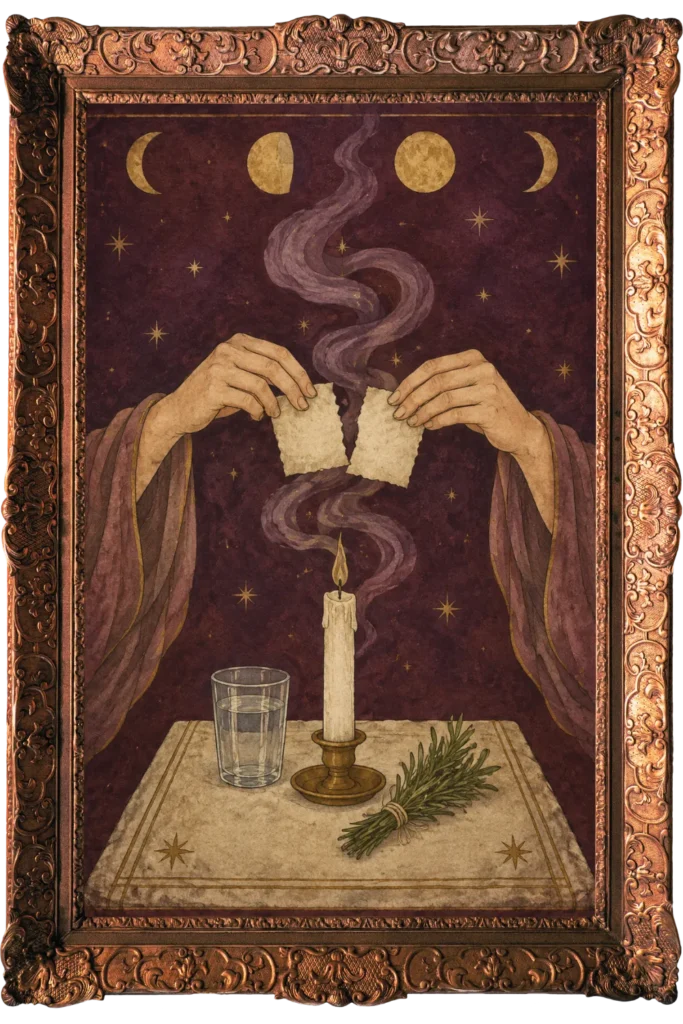
This is the ritual I give everyone who writes to me saying they don’t know where to start. It uses a sheet of paper, a glass of water and a candle or lamp. It works for almost anything, a breakup, a new job, a hard week or just the feeling that something needs to change. Each step shows what to do and why it’s there.
You need a sheet of paper, a pen, a glass of water and a candle or a small lamp.
- ISettle0-1 min
Turn your phone face down in another room. Light a candle or switch on a small lamp. Take 3 slow breaths, longer out than in.
Why This tells your body the next few minutes are different from the rest of the day.
- IIName it1-4 min
Fold a sheet of paper in half. On the left write What I’m done carrying. On the right write What I’m making room for. Fill both halves with a few honest words.
Why Writing turns a fuzzy feeling into something your hands can hold.
- IIISay it4-5 min
Hold a glass of water in both hands and say your intention out loud once, in the present tense. A whisper counts.
Why Saying it out loud makes it real in a way thinking never does.
- IVAct5-8 min
Tear the paper along the fold. Rip the left half into small pieces and drop them in the bin. Fold the right half small and slide it under the glass.
Why The tearing is the heart of the ritual. Your hands do what your mind is deciding.
- VClose8-10 min
Say This is done. What’s next has room. Blow out the candle. Leave the glass overnight, water a plant with it in the morning and keep the note in your wallet until the month ends.
Why A clear ending lets the ritual settle instead of trailing off into scrolling.
That’s it. No chant, no special tools, no perfect moon. If you felt a little silly halfway through, that’s normal. Most people do the first time. Notice how you feel in the morning when you find the note under the glass. That small jolt of oh right, I decided something is the ritual doing its job.
Build Your Own Ritual in 60 Seconds
Want a ritual shaped around your night? Tell the Ritual Builder what you need, how much time you have and what’s already in your home. It puts together all 5 parts for you, checks tonight’s moon phase and points you to the chapter that goes deeper.
3 quick choices. You get a complete ritual with all 5 parts, tonight’s moon phase and the chapter to read next.
No sign up, no email. Nothing you choose is saved or sent anywhere. It all stays in your browser.
What You Need for a Ritual, Much Less Than You Think
The ritual industry would love you to believe you need a $90 starter kit. You don’t. Every tool in a ritual is a helper for your attention. A candle gives your eyes somewhere to rest. Salt and water give your hands something to do. Herbs bring scent, which is the fastest way to change a mood. If you understand what a tool is for, you can always find a substitute in your kitchen.
- A candle or a small lamp
- Paper and a pen
- A glass of water
- 10 quiet minutes
- A small dish of salt
- Kitchen herbs like rosemary, bay leaf or chamomile
- 1 or 2 crystals that you like the look of
- A notebook only for rituals
- Expensive starter kits
- Rare herbs you can’t pronounce
- Anything that makes you feel you’re doing it wrong
- White sage bundles (alternatives below)
About sage. White sage is sacred to several Native American nations and wild plants have been overharvested to meet demand. You can clear a room just as well with rosemary, bay leaves, an open window or sound. Sage vs Palo Santo vs Incense lists gentle alternatives.
When to Do a Ritual – The Moon, the Week and Real Life
Here’s the honest answer first. The best time for a ritual is the time you’ll actually do it. A ritual on a random Tuesday beats a perfect full moon ritual you never get around to.
That said, timing adds meaning and the moon is the easiest clock to follow. It moves through the same phases every 29.5 days, so it gives your rituals a natural rhythm. Each phase has a feeling that matches certain intentions.
| Moon phase | What it suits | A simple ritual | Read next |
|---|---|---|---|
| New moon | Starting, planting, choosing | Write 1 intention for the month and keep it where you’ll see it | New Moon Ritual → |
| Waxing moon | Building, courage, taking the next step | Light a candle before an interview or a first date | Good Luck Ritual → |
| Full moon | Celebrating, gratitude, release | Write what you’re grateful for, then what you’re ready to drop | Full Moon Ritual → |
| Waning moon | Letting go, clearing, cutting ties | Clear the air at home or release someone gently | Cord Cutting Ritual → |
| Any night | Real life, the night you need it | The 10 minute ritual below. The moon is a bonus, not a rule | Sunday Reset Ritual → |
Weekly rituals work beautifully too. A Sunday Reset Ritual closes one week and opens the next and A 5 Minute Morning Ritual gives you a calm start before the chaos. If you follow the sky, How to Read Your Horoscope shows which moon falls in which part of your life this month.
Printable cards for every new and full moon, each with short steps and an intention prompt.
Send Me the Ritual Cards →Simple Rituals for What You Need Right Now
Once you know the 5 parts, every ritual in this book is a variation on them. Here’s where to go next depending on what brought you here tonight.
Candles, Crystals and Herbs – How to Use Them Without Overthinking
These 3 are the classic ritual helpers. You don’t need any of them, but they’re lovely to work with once the basics feel easy.
Candles
A candle is the simplest way to mark the start and end of a ritual. You light it, the ritual begins. You blow it out, the ritual ends. Colors have traditional meanings (green for growth, pink for self love, white for anything), but a plain white tea light is never wrong. Candle Magic for Beginners covers colors and what people read in the flame.
Crystals
Crystals work as anchors for your attention. You hold one while you say your intention, then carry it as a reminder. You need far fewer than shops suggest, as Crystals for Beginners explains. Crystals by Intention then matches stones to what you need. Want the honest view on whether they “do” anything? Do Crystals Actually Do Anything? gives it without hype. Before you rinse one in water, check How to Cleanse and Charge Crystals, because some stones don’t survive it.
Herbs
Start in your kitchen. Rosemary for clearing, bay leaves for wishes, cinnamon for warmth and courage, chamomile and lavender for calm. Use them in tea, in a bath, in a small bowl on your table or simmering on the stove. Scent changes your state faster than almost anything else.
Moon water deserves a mention because it’s everywhere right now. It’s water left out under the moon and charged with an intention. How to Make Moon Water shows you how and What to Do With Leftover Moon Water answers the drinking question honestly.
The One Rule – Rituals Are About You, Not Other People
If this book has a single rule, it’s this one. A ritual works on your own life, your own energy and your own choices. It never targets another person.
That means no rituals to make someone love you, come back, leave their partner or suffer. Partly because it isn’t kind. Partly because it keeps you stuck, focused on a person you can’t control instead of the life you can. If you’re searching for a love spell tonight, please read Love Spells and Ethics first. It explains what to do instead with the same energy.
Even a cord cutting ritual follows this rule. You aren’t doing anything to the other person. You’re releasing your side of the bond, the replaying, the checking, the hoping. That part belongs to you and you’re allowed to set it down.
Ritual Safety – Fire, Herbs and Your Wellbeing
Rituals are gentle, but candles and smoke are real. The National Fire Protection Association reports that about 3 in 5 home candle fires start when something that can burn is too close to the flame and December is the peak month. A few habits keep every ritual safe.
- Never leave a flame alone. Blow it out before you leave the room or close your eyes.
- Keep at least 30 cm (12 inches) between the flame and anything that can burn.
- Use a steady holder on a heat safe surface, away from curtains, pets and children.
- Open a window when you burn herbs or incense. Skip smoke completely if you have asthma.
- Some herbs and essential oils aren’t safe for pets, during pregnancy or on skin. Check before you use them.
- Some crystals fade, crack or release metals in water or sunlight. Look yours up first.
- Moon water is for plants, baths and cleaning unless you started with clean drinking water in a clean glass.
Safe rituals aren’t less magical. They’re the ones you get to keep doing.
And one more kind of safety. A ritual can be a beautiful part of healing, but it isn’t a treatment. If you’re dealing with grief that won’t lift, anxiety, a crisis or something legal or medical, please reach out to a professional alongside your practice. Spell Safety goes deeper on all of this.
When a Ritual Feels Like Nothing Happened
Sometimes you finish a ritual and feel… nothing. No glow, no sign, just a candle stub and a slightly awkward silence. That’s completely normal and it doesn’t mean you did it wrong.
Why Your Spell Didn’t Work goes through 8 honest reasons and how to fix each one.
Do You Need to Be a Witch to Do Rituals?
No. You don’t need to call yourself a witch, join Wicca, follow a religion or leave the one you have. Rituals are human, not owned by any group. Some readers of this book are witches. Some go to church on Sundays. Some just like lighting a candle on the full moon. All of them are welcome. Do You Have to Be a Witch or Wiccan to Do Rituals? answers the most common worries.
Rituals Through the Year
Seasonal rituals connect you to something older than your daily list. The old festivals of the year follow the light, as it shrinks toward midwinter and grows back toward summer. Marking them is one of the oldest things humans do.
If the dates feel overwhelming, choose just one this year. One seasonal ritual you actually do is worth more than 8 you plan.
7 Beginner Mistakes and the Easy Fix for Each
Rituals for Beginners FAQ
Key Takeaways
Where to Go Next
Your journey from here, in recommended order:
A ritual is a feeling you give a shape. You already know how to do it. Now you know why it works.